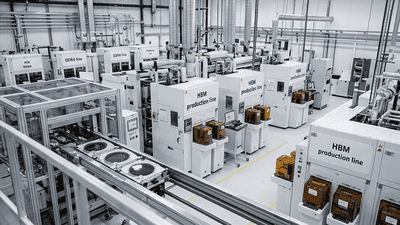
High-Bandwidth Memory (HBM) sits at the heart of modern AI infrastructure. A small group of hyperscale cloud and AI platform providers now buys a very large share of global HBM output, often through multi‑year contracts and co‑investment arrangements. This buying power has helped finance HBM capacity expansion—but it has also created a new kind of risk for memory makers, OSATs, material suppliers and equipment vendors: extreme customer concentration.

Why HBM naturally leads to concentration
HBM is not a generic commodity DRAM product; it is a high‑value, technically complex memory that requires coordinated investment across wafers, TSVs, hybrid bonding, interposers, test, burn‑in and advanced packaging. That complexity pushes both suppliers and customers toward tight, long‑term relationships:
- HBM volumes are still small relative to commodity DRAM, so only hyperscalers and a few leading accelerator vendors have the scale to underwrite dedicated capacity.
- Qualification costs are high. Once a large AI customer has qualified a particular supplier’s HBM module for a platform, switching to a different supplier mid‑cycle is expensive and risky.
- Supply is structurally tight during ramp phases, making long‑term agreements, prepayments and co‑investment more attractive to both sides.
- Design-in cycles for accelerators and AI servers span years, so large buyers naturally become anchor customers for specific generations of HBM.
These forces converge to create scenarios where one or two AI giants dominate demand for certain HBM generations. That dominance amplifies upside when those customers are in aggressive investment mode—but it also magnifies downside if their behavior changes.
Defining customer concentration risk in the HBM context

Customer concentration risk arises when a supplier’s revenue, profit or capacity utilization depends heavily on a small number of customers. In HBM this risk is sharper because:
- HBM-related capex is high and specific. Lines built for HBM cannot easily pivot to other products without cost and time.
- HBM ASPs are elevated; losing a large HBM customer impacts margins disproportionately compared with losing a commodity DRAM customer.
- HBM demand is closely tied to AI capex cycles, which can be volatile and subject to rapid sentiment or policy shifts.
- Contracts often involve prepayments and volume commitments, making renegotiations or cancellations complex and potentially contentious.
Over‑reliance on one AI giant means that any change in that customer’s behavior—slower AI capex, architectural shifts, in‑house memory experiments, or a pivot to another supplier—can ripple through a supplier’s financials and capacity planning.
How over‑reliance typically manifests
In practice, customer concentration risk in HBM shows up in a few recurring patterns:
- Revenue skew: A single AI platform or hyperscaler accounts for a very large share of HBM sales, sometimes through a single accelerator family or AI cluster program.
- Capex tied to one roadmap: Suppliers commit much of their HBM‑linked capex to capacity sized and tuned for one customer’s roadmap, including specific stack counts, module footprints and thermal interfaces.
- Contract terms shaping operations: Production planning, inventory policies and allocation strategies are heavily constrained by one large customer’s delivery windows, SLA terms and qualification criteria.
- Pricing and margin leverage: The dominant buyer uses their scale and strategic importance to negotiate aggressive pricing, tight terms, or co‑investment structures that shift risk toward the supplier.
These manifestations make HBM suppliers more vulnerable to shifts in one customer’s needs and bargaining posture—and less able to balance risk across a diverse portfolio.
What can go wrong: downside scenarios

Concentration risk becomes real when adverse scenarios unfold. A few examples that suppliers should consider in their planning:
- Demand slowdown. The anchor AI customer reduces training cluster capex due to macro conditions, internal efficiency gains, or saturation in certain workloads. HBM orders are delayed or trimmed, leaving suppliers with underutilized capacity and weaker pricing power.
- Architectural shifts. The customer adopts new accelerator architectures emphasizing alternative memory types (e.g., next‑generation GDDR, on‑package caches, disaggregated memory fabrics) for some workloads, reducing their dependence on HBM.
- Supplier diversification. To manage its own risk, the AI giant pushes for dual‑sourcing and spreads orders across multiple HBM vendors. The original anchor supplier faces share loss and pricing pressure.
- In‑house experimentation. The customer explores partial verticalization—co‑designing memory with another vendor or investing in alternative packaging approaches—reducing future reliance on traditional HBM suppliers.
- Contract renegotiation. Changes in demand, competition or cost structure lead the customer to seek improved terms mid‑contract, squeezing margins for the supplier or altering capex plans.
Any one of these scenarios can challenge a supplier’s earnings visibility, return on HBM capex and strategic roadmap, especially when HBM investments were made with a single dominant buyer in mind.
Capital market implications of concentration
Investors care about customer concentration because it influences volatility, valuation multiples and perceived risk. For HBM suppliers, over‑reliance on a single AI giant can lead to:
- Higher earnings beta. Earnings become more sensitive to the capital spending cycles and strategic decisions of one or two major customers.
- Multiple compression. Markets may assign lower valuation multiples to suppliers seen as overly dependent on a single buyer, especially if that buyer is known for aggressive negotiation or capex cyclicality.
- Event‑driven volatility. Announcements by the AI giant—new product launches, capex guidance changes, supplier endorsements or shifts—show up almost immediately in HBM suppliers’ share prices.
- Balance sheet risk. Large, customer‑driven HBM capex programs can strain balance sheets; if expected volume fails to materialize, asset impairment or slower ROI becomes a concern.
Investors will often ask: How much of this supplier’s HBM revenue is tied to one AI customer? How diversified are the end‑markets and customer base? The answers influence portfolio construction and risk appetite.
Strategic benefits of anchor customers—and why suppliers accept the risk

Despite the risks, HBM suppliers actively court and rely on anchor AI customers because the relationship offers real strategic benefits:
- Capex underwriting. Large customers often provide prepayments, co‑investment, or long‑term contracts that reduce financing risk for expensive HBM capacity expansions.
- Technology co‑development. Close engagement with leading AI firms gives suppliers early visibility into future requirements and allows co‑design of modules tailored to next‑generation accelerators.
- Reputation and validation. Being a primary HBM supplier to a top AI platform acts as a powerful signal to other customers, supporting broader demand and pricing.
- Scale benefits. Serving large customers at scale accelerates yield learning and cost reduction, providing process advantages that can be leveraged with other buyers.
In other words, concentration is not accidental; it reflects a deliberate trade‑off between stability and upside on one side and dependency on the other. The challenge is managing that trade‑off intelligently.
Mitigation strategies for HBM suppliers
Suppliers can pursue several strategies to reduce net concentration risk while preserving the benefits of anchor customers:
- Diversify customers and end‑markets. Seek additional HBM design‑ins with other hyperscalers, GPU/accelerator vendors, HPC institutions and specialized ASIC makers to broaden revenue sources.
- Tiered product portfolio. Offer multiple HBM product tiers—performance‑max, cost‑optimized and capacity‑oriented—that appeal to a wider set of customers and use cases.
- Contract design. Structure long‑term agreements with balanced clauses: volume commitments, price‑adjustment mechanisms, and clear terms for changes or renegotiations to prevent sudden shocks.
- Capex pacing and modularity. Build HBM capacity in modular increments, aligning major expansions with multi‑customer demand signals rather than single customer forecasts alone.
- Operational flexibility. Design lines and testing flows so that, where feasible, they can serve adjacent products (e.g., other stacked memory or advanced DRAM) if a specific HBM program slows.
- Scenario planning. Regularly run “what‑if” analyses for demand cuts, dual‑sourcing, architectural shifts and renegotiations to ensure the company can adjust without destabilizing its finances.
These strategies do not remove concentration risk, but they make it more manageable and less existential if a single AI giant changes course.
Practical risk indicators to monitor
Suppliers and investors can track specific indicators to gauge how exposed a company is to customer concentration and how that risk is evolving:
- Revenue share by customer. Percentage of total and HBM‑related revenue from the largest customer; trends over time reveal whether concentration is rising or falling.
- Contract duration and terms. Length of agreements, presence of take‑or‑pay clauses, flexibility provisions, and mechanisms for price adjustments or renegotiation.
- Capex alignment. Proportion of current and planned HBM capex justified primarily by one customer’s roadmap versus by multi‑customer demand.
- Pipeline diversity. Number and variety of active HBM design‑in projects across customers and end‑markets; more diversity reduces dependence on any single pipeline.
- Margin sensitivity. Modeled impact on gross margin if the anchor customer reduces volume, demands price cuts, or shifts to dual sourcing.
Combining these indicators into a simple dashboard helps management and investors spot rising concentration risk before it becomes acute.
Balancing depth and diversification in customer relationships
HBM suppliers face a balancing act: deep, integrated relationships with a few key AI giants versus broader, shallower relationships across many customers. The right balance depends on the firm’s size, capital structure and strategic ambitions:
- Smaller or heavily leveraged firms may need anchor customers more to secure financing and validate technology, but must monitor dependence closely.
- Larger, more diversified companies can afford to trade some depth for breadth, pursuing multiple anchor relationships and actively cultivating second‑tier customers.
- Firms with strong process IP or vertical integration (including packaging and test) have more leverage to negotiate balanced contracts and attract a wider customer set.
In all cases, the objective is not to avoid concentration entirely, but to ensure that concentration is a conscious strategic choice with backup plans—not an unexamined vulnerability.
Recommendations for different stakeholders
Different actors in the HBM ecosystem should approach concentration risk with tailored strategies:
- HBM suppliers. Map customer exposure, diversify design‑ins, and structure contracts and capex so no single AI customer can jeopardize the company’s core viability.
- OSATs and packaging houses. Avoid building entire advanced packaging lines for a single anchor without secondary customers; cultivate other memory makers and accelerator vendors to spread utilization risk.
- Materials and equipment vendors. Recognize that their own demand may be indirectly concentrated via HBM suppliers; seek customers across multiple memory and packaging formats to reduce dependency on one HBM ramp.
- Investors. Incorporate customer concentration metrics into valuation models; reward firms that balance anchor relationships with diversification and penalize those with excessive single‑buyer exposure and weak mitigation plans.
- AI giants themselves. While benefiting from bargaining power, they also face supply risk if over‑concentration discourages supplier investment or creates financial fragility; supporting a healthy multi‑supplier ecosystem can be in their long‑term interest.
Conclusion
Customer concentration risk in the HBM era is a natural outcome of a technology that is capital‑intensive, complex, and tightly bound to a small number of very large AI buyers. Over‑reliance on a single AI giant can magnify both upside and downside for HBM suppliers, affecting revenue stability, margins, capex ROI and valuation. The key is not to avoid anchor customers but to manage dependence deliberately: diversify design‑ins, structure robust contracts, pace capex, and maintain operational flexibility. For investors and management teams, systematically tracking customer exposure and running realistic downside scenarios will be essential as HBM becomes more central to the global AI infrastructure stack.